



Medicare Advantage vs. Medicare Supplement in 2026: Which Is Better for You?
Medicare Advantage vs. Medicare Supplement in 2026: Which Is Better for You?
If you’re turning 65 or already enrolled in Medicare, one of the biggest decisions you’ll face is this:
Should you choose a Medicare Advantage plan or a Medicare Supplement (Medigap) plan?
This is one of the most common questions I get from clients in Indiana, Florida, and Alabama. The answer isn’t one-size-fits-all — it depends on your health, budget, travel habits, and long-term goals.
In this guide, I’ll walk you through the core differences, cost comparisons, network considerations, and who each option is best for in 2026.
What’s the Basic Difference?
Medicare Advantage (Part C)
Medicare Advantage plans are offered by private insurance companies approved by Medicare. These plans replace Original Medicare (Parts A & B) and usually include:
- Hospital coverage (Part A)
- Medical coverage (Part B)
- Often prescription drug coverage (Part D)
- Extra benefits like dental, vision, hearing, and gym memberships
You still pay your Part B premium, but you receive your Medicare benefits through the private insurance company.
Medicare Supplement (Medigap)
A Medicare Supplement plan works alongside Original Medicare.
You keep Original Medicare (Parts A & B), and the Supplement plan helps pay deductibles, coinsurance, copays, and other out-of-pocket gaps. Most people also add a standalone Part D prescription drug plan.
Medigap plans are standardized (Plan G, Plan N, etc.), meaning coverage is the same regardless of carrier — the difference is price and service.
Cost Comparison: How They Really Work
Medicare Advantage Costs
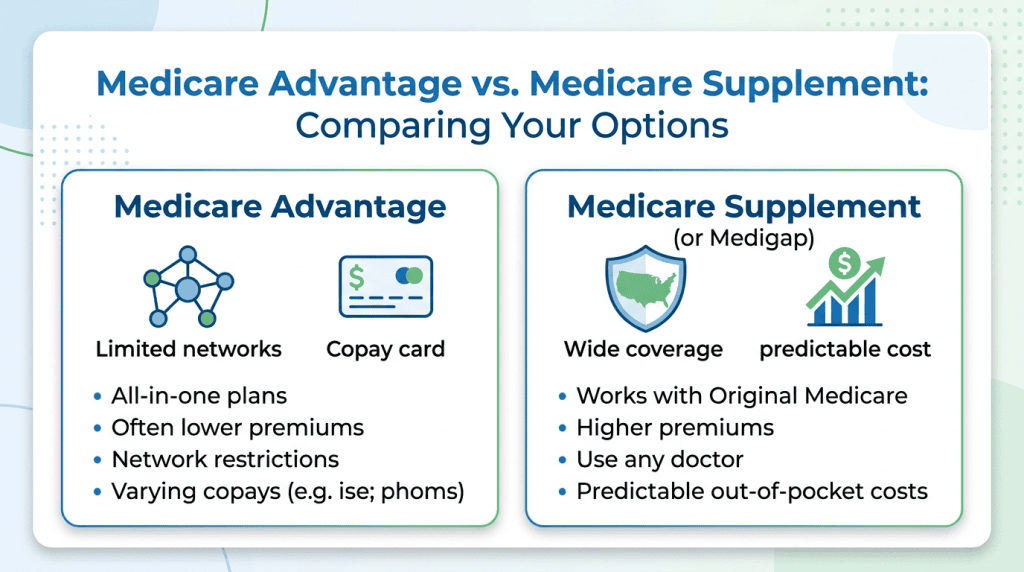
- Often low or even $0 monthly premium (beyond your Part B premium)
- Copays for doctor visits and specialists
- Daily copays for hospital stays
- An annual maximum out-of-pocket limit
Many counties across Indiana, Florida, and Alabama offer competitive Advantage premiums. However, costs occur as you use services — meaning you pay as you go.
Medicare Supplement Costs
- Higher monthly premium
- Very little out-of-pocket when you use care
- No network restrictions
- No referral requirements
With plans like Plan G, once you meet your small annual Part B deductible, Medicare pays its share and your supplement typically picks up most of the remaining balance.
You pay more monthly — but generally gain greater predictability.
Network Differences (This Is Huge)
Medicare Advantage = Networks
Most Advantage plans are either HMO or PPO. That means:
- You may need to stay in-network
- Your doctor must participate in the plan
- You may need referrals for specialists
If your doctor leaves the network, you may need to switch providers. This can matter in rural Indiana counties, parts of Alabama, and even certain Florida markets.
Medicare Supplement = Nationwide Access
With a supplement plan:
- You can see any doctor in the U.S. who accepts Medicare
- No referrals are required
- Excellent for frequent travelers and snowbirds
If you split time between Indiana and Florida, this flexibility can be a major deciding factor.
Travel Considerations
Medicare Advantage: Emergency coverage works nationwide, but routine care is generally strongest within your local service area.
Medicare Supplement: Works anywhere in the United States where Medicare is accepted.
For retirees who travel often or live part of the year in another state, this is an important distinction.
Long-Term Strategy (Often Overlooked)
When you first turn 65, you have a guaranteed issue window for Medicare Supplement plans. During this time:
- You cannot be denied
- You cannot be charged more due to health conditions
After that window closes, switching from Medicare Advantage to a Supplement plan may require medical underwriting in many states.
That means you could be denied or pay more based on health conditions.
This is why it’s important to think long-term — not just about this year’s premium.
Extra Benefits: Are They Worth It?
Medicare Advantage plans often include:
- Dental coverage
- Vision coverage
- Hearing benefits
- Over-the-counter allowances
- Gym memberships
These benefits can be valuable, but they vary by county and plan. Medicare Supplement plans typically do not include these extras, though separate policies are available.
Who Should Consider Medicare Advantage?
- Individuals who are relatively healthy
- Those who prefer lower monthly premiums
- People comfortable with network-based care
- Those who rarely travel outside their home state
- Anyone who values bundled extra benefits
Who Should Consider Medicare Supplement?
- Those who want nationwide provider flexibility
- Frequent travelers or snowbirds
- Individuals who prefer predictable healthcare costs
- People who want minimal surprise bills
- Those who value long-term stability
Common Mistakes to Avoid
- Choosing based only on premium
- Not checking provider networks
- Ignoring long-term switching rules
- Assuming all Advantage plans are the same
- Failing to review drug coverage annually
The Bottom Line
There isn’t a universally “better” option — only what fits your health needs, financial comfort level, and lifestyle.
If you’re turning 65, you may also want to review our step-by-step guide here:
Welcome to Medicare – EZ Guide.
If you’d like personalized help comparing Medicare Advantage and Medicare Supplement plans in your county,
book a free appointment with a local health insurance agent or call/text 317‑482‑7063.
A short conversation can help you avoid costly mistakes and choose a plan with confidence.